 dd1433a20d
This brings better compatibility with the Julia package ecosystem.
Now, if Gnuplot.jl is used in an environment capable of showing
multimedia content (IJulia, VS Code, Pluto), their internal viewer
will take precedence over using gnuplot's built-in viewer. In the
REPL, gnuplot viewer is still used by default.

In VS Code, for example, when the *Use Plot Pane* settings is enabled,
the plots show in that pane, but when it is disabled, gnuplot viewer is
automatically used.

For people who prefer to always use the gnuplot viewer, they can set
Gnuplot.options.gpviewer to true. This should result in the same
behaviour as before this commit.
Gnuplot.jl
A Julia interface to gnuplot.


Gnuplot.jl is a simple package able to send both data and commands from Julia to an underlying gnuplot process. Its main purpose it to provide a fast and powerful data visualization framework, using an extremely concise Julia syntax. It also has automatic display of plots in Jupyter, Juno and VS Code.
Installation
Install with:
]add Gnuplot
A working gnuplot package must be installed on your platform.
You may check the installed Gnuplot.jl version with:
]st Gnuplot
If the displayed version is not v1.4.0 you are probably having a dependency conflict. In this case try forcing installation of the latest version with:
]add Gnuplot@1.4.0
and check which package is causing the conflict.
Test package:
using Gnuplot
println(Gnuplot.gpversion())
test_terminal()
Quick start
The following examples are supposed to be self-explaining. See documentation for further informations.
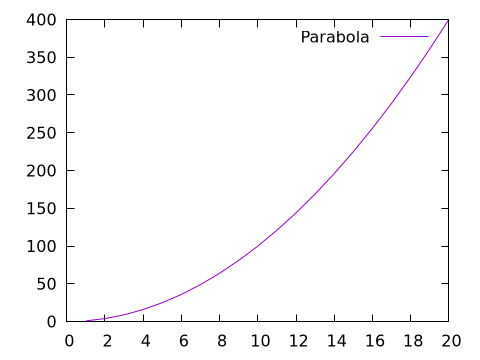
A simple parabola
x = 1.:20
@gp x x.^2 "with lines title 'Parabola'"
save(term="pngcairo size 480,360", output="examples/ex1.png")
save("parabola.gp")  # => save a script file with both data and command to re-create the plot.
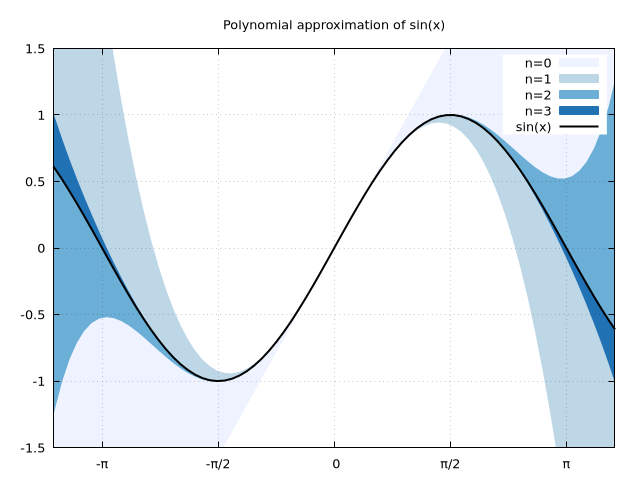
A slightly more complex plot, with unicode on X tics
x = -2pi:0.1:2pi
approx = fill(0., length(x));
@gp tit="Polynomial approximation of sin(x)" key="opaque" linetypes(:Blues_4)
@gp :- "set encoding utf8" raw"""set xtics ('-π' -pi, '-π/2' -pi/2, 0, 'π/2' pi/2, 'π' pi)"""
@gp :- xr=3.8.*[-1, 1] yr=[-1.5,1.5] "set grid front"
@gp :- x sin.(x) approx .+=  x          "w filledcurve t 'n=0' lt 1"
@gp :- x sin.(x) approx .+= -x.^3/6     "w filledcurve t 'n=1' lt 2"
@gp :- x sin.(x) approx .+=  x.^5/120   "w filledcurve t 'n=2' lt 3"
@gp :- x sin.(x) approx .+= -x.^7/5040  "w filledcurve t 'n=3' lt 4"
@gp :- x sin.(x)                        "w l t 'sin(x)' lw 2 lc rgb 'black'"
save(term="pngcairo size 640,480", output="examples/ex2.png")
Multiplot: a 2D histogram contour plot and a 3D surface plot
x = randn(10_000)
y = randn(10_000)
h = hist(x, y, bs1=0.25, nbins2=20)
@gp "set multiplot layout 1,2"
@gp :- 1 key="outside top center box horizontal" "set size ratio -1" h
clines = contourlines(h, "levels discrete 10, 30, 60, 90");
for i in 1:length(clines)
    @gp :- clines[i].data "w l t '$(clines[i].z)' lw $i lc rgb 'gray'" :-
end
@gsp :- 2 h.bins1 h.bins2 h.counts "w pm3d notit"
save(term="pngcairo size 660,350 fontscale 0.8", output="examples/ex3.png")

Further examples
The main gallery of examples is maintained in a separate repository: https://lazarusa.github.io/gnuplot-examples/
Since Gnuplot.jl is just a transparent interface (not a wrapper) it exposes all capabilities of the underlying gnuplot process, hence pure-gnuplot examples also applies to Gnuplot.jl. Further examples are available here: